
About Course
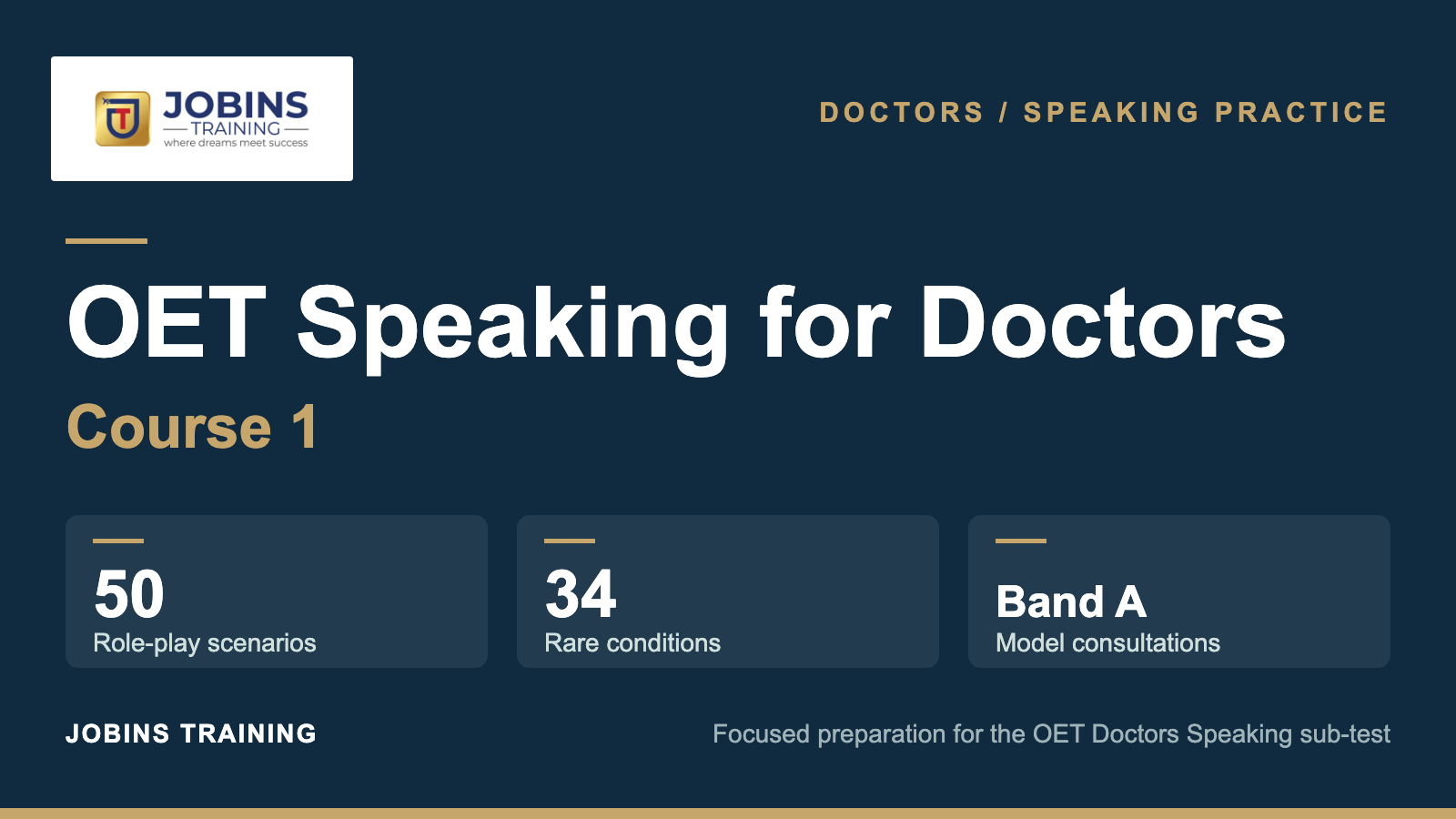
Your path to OET Speaking excellence for doctors: 50 role plays and full Band A responses, rebuilt as a complete online programme.
Course Content
Foundation — How the OET Speaking Test Works
-
Welcome — How This Course Works
-
The OET Speaking Sub-Test for Doctors
-
The Nine Assessed Criteria
-
The Four-Step Consultation — Open, Explore, Explain, Close
-
Functional Language for the Consultation
-
Doctor Cards, Patient Cards and the Three-Minute Preparation Window
-
Course Map — What You Will Learn and How to Work Through It
Craft — Building Band A Consultation Skills
-
Reading the Role-Play Card Like an Examiner
-
Building Rapport Without Wasting Time
-
Explaining a Serious Diagnosis in Plain English
-
Eliciting and Responding to the Patient’s Real Fear
-
Shared Decision-Making and Consent
-
Safety-Netting: Red Flags, Timeframes and Who to Contact
-
Closing, Summarising and the Final Thirty Seconds
Guided Analysis — Band A Consultations Unpacked
-
Guided Analysis 1 — Chest Pain in a 55-Year-Old
-
Guided Analysis 2 — New Type 2 Diabetes
-
Guided Analysis 3 — Five Failing Consultations
Module 1 — Cardiology and Inherited Arrhythmia
-
Role-Play 1 — Arrhythmogenic Right Ventricular Cardiomyopathy (ARVC)
-
Role-Play 2 — Arrhythmogenic Right Ventricular Cardiomyopathy (ARVC)
-
Role-Play 3 — Arrhythmogenic Right Ventricular Cardiomyopathy (ARVC)
-
Role-Play 4 — Long QT Syndrome (LQTS)
-
Role-Play 5 — Pulmonary Arterial Hypertension (PAH)
Module 2 — Respiratory, Ciliary and Pulmonary Circulation Disease
-
Role-Play 6 — Kartagener’s Syndrome
-
Role-Play 7 — Pulmonary Alveolar Proteinosis (PAP)
-
Role-Play 8 — Lymphangioleiomyomatosis (LAM)
-
Role-Play 9 — Hereditary Haemorrhagic Telangiectasia (HHT)
Module 3 — Gastroenterology, Hepatology and Endocrine Tumours
-
Role-Play 10 — Primary Sclerosing Cholangitis (PSC)
-
Role-Play 11 — Primary Sclerosing Cholangitis (PSC)
-
Role-Play 12 — Primary Sclerosing Cholangitis (PSC)
-
Role-Play 13 — Pheochromocytoma
-
Role-Play 14 — Pheochromocytoma
-
Role-Play 15 — Whipple’s Disease
Module 4 — Haematology and Immune Deficiency
-
Role-Play 16 — Chronic Myeloid Leukaemia (CML)
-
Role-Play 17 — Thrombotic Thrombocytopenic Purpura (TTP)
-
Role-Play 18 — Thrombotic Thrombocytopenic Purpura (TTP)
-
Role-Play 19 — Atypical Haemolytic Uraemic Syndrome (aHUS)
-
Role-Play 20 — Paroxysmal Nocturnal Haemoglobinuria (PNH)
-
Role-Play 21 — Common Variable Immunodeficiency (CVID)
Module 5 — Metabolic, Renal and Genetic Skin Disease
-
Role-Play 22 — Acute Intermittent Porphyria (AIP)
-
Role-Play 23 — Acute Intermittent Porphyria (AIP)
-
Role-Play 24 — Wilson’s Disease
-
Role-Play 25 — Wilson’s Disease
-
Role-Play 26 — Alport Syndrome
-
Role-Play 27 — Maple Syrup Urine Disease (MSUD)
-
Role-Play 28 — Familial Mediterranean Fever (FMF)
-
Role-Play 29 — Primary Hyperoxaluria (PH)
-
Role-Play 30 — Epidermolysis Bullosa (EB)
-
Role-Play 31 — Pompe Disease
Module 6 — Neurology and Neuromuscular Disease
-
Role-Play 32 — Neuromyelitis Optica Spectrum Disorder (NMOSD)
-
Role-Play 33 — Neuromyelitis Optica Spectrum Disorder (NMOSD)
-
Role-Play 34 — Neuromyelitis Optica Spectrum Disorder (NMOSD)
-
Role-Play 35 — Stiff Person Syndrome (SPS)
-
Role-Play 36 — Stiff Person Syndrome (SPS)
-
Role-Play 37 — Stiff Person Syndrome (SPS)
-
Role-Play 38 — Myasthenia Gravis (MG)
-
Role-Play 39 — Myasthenia Gravis (MG)
-
Role-Play 40 — Myasthenia Gravis (MG)
-
Role-Play 41 — Friedreich’s Ataxia
-
Role-Play 42 — Friedreich’s Ataxia
-
Role-Play 43 — Huntington’s Disease (HD)
-
Role-Play 44 — Hallervorden-Spatz Disease (PKAN)
-
Role-Play 45 — Duchenne Muscular Dystrophy (DMD)
Module 7 — Rheumatology, Immunology and Multisystem Disease
-
Role-Play 46 — Behçet’s Disease
-
Role-Play 47 — Behçet’s Disease
-
Role-Play 48 — Mast Cell Activation Syndrome (MCAS)
-
Role-Play 49 — Adult-Onset Still’s Disease (AOSD)
-
Role-Play 50 — Eosinophilic Granulomatosis with Polyangiitis (EGPA)
Mastery — The Difficult Consultation
-
When the Patient Is Distressed or Crying
-
When the Patient Is Angry or Complaining
-
When the Patient Refuses What You Recommend
-
When a Relative Takes Over the Consultation
-
When You Cannot Name the Diagnosis
-
When the Patient Believes Something That Is Not True
-
When the Patient Wants a Guarantee You Cannot Give
-
Working Through an Interpreter or With Limited English
-
Capacity, Best Interests and the Patient Who Cannot Decide
-
Recovering a Consultation That Has Gone Wrong
Timed Mock Tests and Extra Practice
-
Timed Mock Test 1 — Two Consultations Under Examination Conditions
-
Timed Mock Test 2 — Two Consultations Under Examination Conditions
-
Timed Mock Test 3 — Two Consultations Under Examination Conditions
-
Timed Mock Test 4 — Two Consultations Under Examination Conditions
-
Timed Mock Test 5 — Two Consultations Under Examination Conditions
-
Timed Mock Test 6 — Two Consultations Under Examination Conditions
-
Timed Mock Test 7 — Two Consultations Under Examination Conditions
-
Timed Mock Test 8 — Two Consultations Under Examination Conditions
-
Timed Mock Test 9 — Two Consultations Under Examination Conditions
-
Timed Mock Test 10 — Two Consultations Under Examination Conditions
-
Extra Practice 1 — Acute Intermittent Porphyria (AIP)
-
Extra Practice 2 — Pheochromocytoma
-
Extra Practice 3 — Behçet’s Disease
-
Extra Practice 4 — Stiff Person Syndrome (SPS)
-
Extra Practice 5 — Acute Intermittent Porphyria (AIP)
-
Extra Practice 6 — Primary Sclerosing Cholangitis (PSC)
-
Extra Practice 7 — Huntington’s Disease (HD)
-
Extra Practice 8 — Duchenne Muscular Dystrophy (DMD)
-
Extra Practice 9 — Familial Mediterranean Fever (FMF)
-
Extra Practice 10 — Paroxysmal Nocturnal Haemoglobinuria (PNH)
Final AI Speaking Assessment
-
Final AI Role-Play 1 — Thrombotic Thrombocytopenic Purpura (TTP)
-
Final AI Role-Play 2 — Primary Sclerosing Cholangitis (PSC)
Student Ratings & Reviews

No Review Yet