
A strong OET Reading Part C answer starts before you compare the options. First decide exactly how strong the writer’s claim is. Is the writer reporting an observation, suggesting a possible explanation, or proving that one thing caused another? This distinction is easy to miss when you read quickly, especially after a long shift.
What the official sample shows
In the current official OET paper sample, Reading Parts B and C share a 45-minute period. Part C contains two healthcare texts and 16 questions, numbered 7–22. Each question has four options, A–D. The official instructions award one mark for each correct answer and do not deduct marks for an incorrect answer. The sample questions ask about the writer’s purpose, attitude, implications, references and the force of particular words or phrases.
Checked on 15 November 2026 against the official OET Reading Sample Test 1, Parts B and C and the Cambridge English OET preparation and sample-test directory. The practice below is original Jobins Training material. It is not an official examination question.
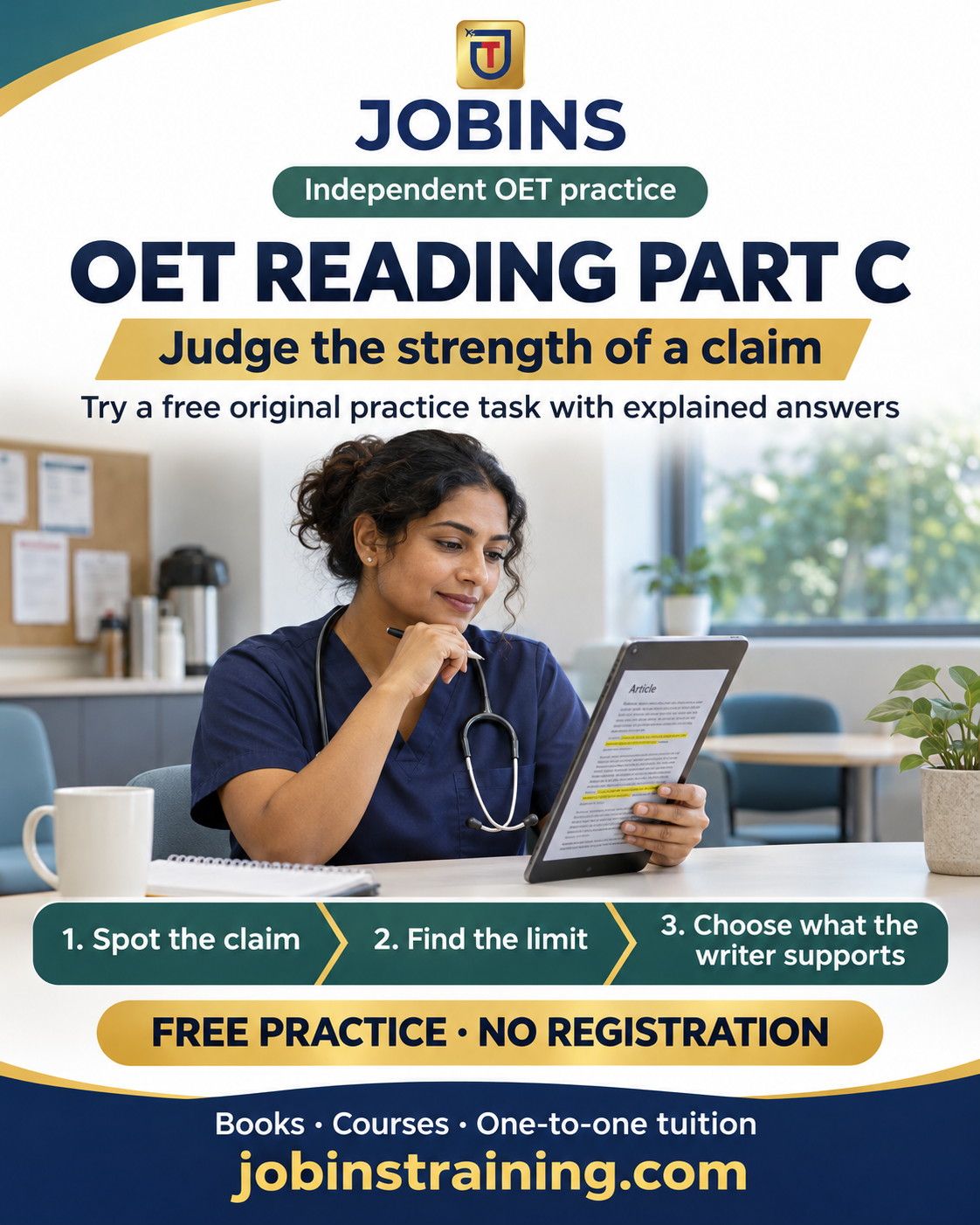
The three-step claim check
1. Spot the claim
Underline the sentence that actually answers the question. Ignore interesting background details until you know which idea matters. A question about the writer’s conclusion may depend on one cautious sentence near the end of a paragraph.
2. Find the limit
Look for words that narrow the conclusion: may, appears, suggests, cannot establish, in this group, at this stage or further research is needed. These are not filler. They tell you what the writer is unwilling to claim.
3. Choose what the writer supports
Reject an option if it changes an association into a cause, removes a stated limitation, or turns a possibility into certainty. The best option can sound less dramatic because it stays inside the evidence.
Try this original mini-practice
A rehabilitation service added evening appointments in January. Attendance rose from 62% in the previous three months to 74% during the next three months. The service also introduced text-message reminders at the same time, and there were fewer weather-related cancellations in the later period. The audit shows that attendance improved after the changes, but it cannot tell us how much of the improvement came from evening access, the reminders or the different weather.
Question: Which conclusion is best supported by the passage?
- Evening appointments caused the improvement in attendance.
- Text-message reminders were more effective than evening appointments.
- Attendance improved after several circumstances changed, so the audit cannot isolate one cause.
- Weather was the main reason for poor attendance in the earlier period.
Open the answer and reasoning after you choose
Answer: C. The passage reports a before-and-after improvement, but three things differed between the periods. The words “cannot tell us how much” limit the conclusion. A, B and D each select one explanation as the cause without evidence that separates it from the others.
A ten-minute review for busy shifts
- Minutes 1–3: Read one paragraph and write its main claim in no more than ten words.
- Minutes 4–5: Circle every limiting word or phrase.
- Minutes 6–8: Compare each option with the claim. Mark any option that adds certainty, cause or scope.
- Minutes 9–10: Explain why the correct option is supported and why one tempting distractor goes too far.
This short routine is useful on a workday. On a day off, combine it with a timed Part C text so that the reasoning also becomes faster.
Use the free Jobins Training Reading practice
The free Jobins Training OET Reading practice test is public and requires no registration. It includes a complete 42-question practice set: Part A, six Part B workplace extracts and two Part C healthcare articles. You can attempt the questions on screen or on paper, then open the answer reviews and evidence. The page also includes a short “Read the strength of a claim” drill for a quick study session.
Choose the next step that fits your goal
| Your goal | Useful next step |
|---|---|
| Try the format before paying | Use the free 42-question Reading practice and review the explanations. |
| Build a regular independent routine | See OET Reading for Nurses Book 1, with a free Part B sample on the product page and paid PDF or paperback editions. |
| Practise across several Reading resources | Compare the OET Reading eBook bundle. The shop shows the price and available delivery terms for your location. |
| Prefer structured lessons | Browse self-paced OET courses. |
| Need personal feedback and a study plan | Read about one-to-one OET tuition. Lesson times are arranged with the tutor, subject to availability. |
Jobins Training is independent of OET. This article teaches a reading method through original material and does not reproduce confidential examination content. Practice performance does not guarantee an official result.
Put this into practice
Compare these course outlines and choose the practice that matches your next goal.