Skip to content
Jobins TrainingWHERE DREAMS MEET SUCCESS

OET · Physiotherapy

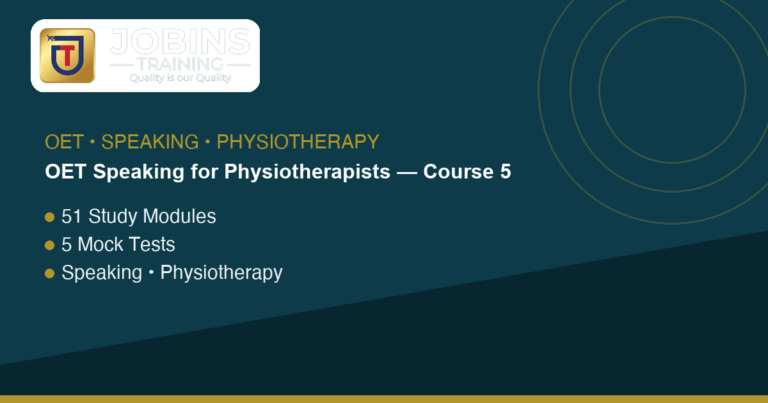
OET Speaking for Physiotherapists — Course 5

Explore Mild stroke, hemiparesis + balance fear, Below-knee amputation, diabetes + prosthesis and Ischaemic stroke, right-side hemiplegia.

£19.99 · one course

Prefer live guidance? Explore flexible one-to-one tuition.

OET Speaking for Physiotherapists — Course 5 — Mild stroke, hemiparesis + balance fear
51published topic sections
76lesson entries
5practice quiz entries

Choose your focus

What you can work on

Mild stroke, hemiparesis + balance fear

Use the matching material in the outline below to build a focused practice session.

Below-knee amputation, diabetes + prosthesis

Use the matching material in the outline below to build a focused practice session.

Ischaemic stroke, right-side hemiplegia

Use the matching material in the outline below to build a focused practice session.

Is this the right collection for you?

This collection is for learners working on OET Speaking in physiotherapy contexts. Compare the topic list with the practice you have already completed. Choose this course when its situations or tasks address a gap you want to work on.

For independent study, attempt an activity first, review the relevant lesson or example, then repeat the part you want to improve. Course numbers identify separate collections; they do not promise a particular exam score or a fixed level of difficulty.

Inside the course

Your topic and practice outline

These are the published lesson and quiz headings. The counts describe entries in the course; they are not video hours or a promise that an assessment service is active.

The OET Speaking test & what examiners mark
  • A1.1 Test format
  • A1.2 The four scored criteria
  • A1.3 The three pillars
Politeness toolkit
  • Greeting and building rapport
  • Showing empathy and understanding
  • Giving explanations clearly
  • Seeking consent and cooperation
  • Offering reassurance
  • Closing the session
Six essential strategies
  • S1. Begin with a warm, professional introduction
  • S2. Build rapport and show empathy
  • S3. Explain clearly, avoid jargon
  • S4. Involve the patient actively
  • S5. Handle concerns calmly and reassuringly
  • S6. Summarise and close politely
Handling three patient types
  • P1. Anxious patients
  • P2. Resistant patients
  • P3. Uninformed/confused patients
  • Combined behaviours
The 5-step role-play framework
  • The 5-step role-play framework
  • Step 1 — Opening & introduction
  • Step 2 — Information gathering
  • Step 3 — Explanation & education
  • Step 4 — Reassurance & encouragement
  • Step 5 — Closing & summarising
Advanced communication for Grades A/B
  • T1. Analogies and everyday language
  • T2. Giving lifestyle advice politely
  • T3. Handling long recovery times / impatience
  • T4. Motivating low-compliance patients
  • T5. Managing sensitive emotions
  • T6. Advanced closing
Ten common mistakes and fixes
  • Ten common mistakes and fixes
Rotator cuff repair, early rehab
  • Rotator cuff repair, early rehab
Mild stroke, hemiparesis + balance fear
  • Mild stroke, hemiparesis + balance fear
Parkinson's disease, newly diagnosed
  • Parkinson's disease, newly diagnosed
ACL reconstruction, young athlete
  • ACL reconstruction, young athlete
Total hip replacement, first session
  • Total hip replacement, first session
COPD, pulmonary rehabilitation
  • COPD, pulmonary rehabilitation
Multiple sclerosis, newly diagnosed
  • Multiple sclerosis, newly diagnosed
Ankylosing spondylitis, young adult
  • Ankylosing spondylitis, young adult
Cystic fibrosis, airway clearance
  • Cystic fibrosis, airway clearance
Spinal cord injury
  • Spinal cord injury
Guillain-Barré syndrome
  • Guillain-Barré syndrome
Burns rehabilitation, arms + chest
  • Burns rehabilitation, arms + chest
Below-knee amputation, diabetes + prosthesis
  • Below-knee amputation, diabetes + prosthesis
Total knee replacement, osteoarthritis
  • Total knee replacement, osteoarthritis
Cerebral palsy — adult spastic + paediatric diplegia
  • Cerebral palsy — adult spastic + paediatric diplegia
Double lung transplant, pulmonary fibrosis
  • Double lung transplant, pulmonary fibrosis
Ménière's disease, vestibular rehab
  • Ménière's disease, vestibular rehab
Myocardial infarction, cardiac rehab
  • Myocardial infarction, cardiac rehab
Ischaemic stroke, right-side hemiplegia
  • Ischaemic stroke, right-side hemiplegia
Motor neurone disease / ALS
  • Motor neurone disease / ALS
Post-polio syndrome
  • Post-polio syndrome
Chronic fatigue syndrome / ME
  • Chronic fatigue syndrome / ME
MS, long-standing worsening
  • MS, long-standing worsening
Parkinson's, advanced with freezing
  • Parkinson's, advanced with freezing
COPD, advanced with exacerbation fear
  • COPD, advanced with exacerbation fear
Fibromyalgia, widespread pain + fatigue
  • Fibromyalgia, widespread pain + fatigue
Muscular dystrophies — childhood-onset spectrum
  • Muscular dystrophies — childhood-onset spectrum
Osteogenesis imperfecta, child + anxious parents
  • Osteogenesis imperfecta, child + anxious parents
Diabetic peripheral neuropathy, falls risk
  • Diabetic peripheral neuropathy, falls risk
Myasthenia gravis, fluctuating weakness
  • Myasthenia gravis, fluctuating weakness
Charcot-Marie-Tooth disease, young adult
  • Charcot-Marie-Tooth disease, young adult
Huntington's disease, chorea + behaviour
  • Huntington's disease, chorea + behaviour
Multiple system atrophy, autonomic + motor
  • Multiple system atrophy, autonomic + motor
Progressive supranuclear palsy, falls backwards
  • Progressive supranuclear palsy, falls backwards
Friedreich's ataxia, young adult
  • Friedreich's ataxia, young adult
Syringomyelia, cyst with dissociated signs
  • Syringomyelia, cyst with dissociated signs
Spina bifida , child + family
  • Spina bifida , child + family
Ehlers-Danlos, hypermobility type
  • Ehlers-Danlos, hypermobility type
Scleroderma, skin + joint tightening
  • Scleroderma, skin + joint tightening
Dermatomyositis, proximal weakness + rash
  • Dermatomyositis, proximal weakness + rash
C7. Lifestyle-advice softeners
  • C7. Lifestyle-advice softeners
Glossary
  • Glossary
Mock Tests

Practice quizzes

  • Post-surgical Orthopaedics
  • Neuro-rehabilitation: Stroke & Parkinson's
  • Cardiorespiratory: COPD & Cystic Fibrosis
  • Complex Neuro &-paediatrics: GBS/MS, Child with Carer
  • Rheumatology & Progressive Conditions: AS & Dermatomyositis

A useful next read

Before you choose

What does the price cover?

The displayed price is for this individual course. Other numbered courses are separate products. Review the checkout details and terms before paying.

What format does this course use?

The published outline contains online lesson entries and, where shown, practice quizzes. Check a specific resource or access requirement with Jobins Training if it is essential to your purchase. No live tuition or active AI assessment is promised by this page.

How do I access a purchased course?

Use the account associated with your order and return to the student dashboard after enrolment is confirmed. Keep your order details for support. An access duration or lifetime-access promise has not been verified here.

Can I ask about the content first?

Yes. Contact Jobins Training with the course title and the topic or resource you want to check. The team can help you decide whether this collection fits your needs.

Compare related courses

Ready for this topic set?

OET Speaking for Physiotherapists — Course 5 · £19.99

Terms and course policies · Student dashboard